In Conversation with Faith in Futures

Access is often spoken about as though it’s a matter of ambition - we're told to work hard and stay focused. But for many talented young people, the reality is far more complicated. Opportunity is not always distributed in proportion to potential. Financial barriers, structural inequity and lack of support often stand between deserving individuals and the futures they’ve worked tirelessly toward. That is where Faith in Futures steps in.
The initiative exists to identify, support and invest in talented individuals from under-resourced backgrounds, helping them reach their full potential through funding support, scholarships and community-led giving. Right now, that mission is focused on Gabriella Oppong, a Lancaster University Law graduate who has secured an offer to study Education Policy at the University of Pennsylvania which is an Ivy League institution. Despite receiving some financial aid, a significant funding gap remains - and with deadlines approaching, the urgency is real.
We sat down with Sena, founder of Faith in Futures, to talk about what inspired the initiative, the realities of access, and why Gabriella’s story is about far more than one student.
What first led you to start Faith in Futures, and what made this work feel necessary?
Running my own scholarship board is something I have had on my vision board for a few years now.
I was privileged to be awarded a scholarship to study in America in 2015. But in the middle of my second year at university, the funding was removed.
I was 19 at the time and completely unable to cover my tuition myself. My dad was already doing everything he could to support our family of six on his Royal Mail salary, covering my food and accommodation as best he could. I was trying to make $300 last an entire semester, too afraid to call home and ask for more because I knew it would only create more stress.
Studying in America on a soccer scholarship had been a dream of mine since I was a teenager. To have that dream end so abruptly was heartbreaking, and it took me a long time to recover.
Faith in Futures exists because I know what that feels like. It exists so people from under-resourced backgrounds can dream big, receive meaningful support, and actually reach the futures they deserve.
There’s something deeply personal about building solutions from lived experience. Faith in Futures is not abstract philanthropy. It’s rooted in the memory of what it means to be talented, capable and full of promise but blocked by circumstances outside your control.
That urgency is what makes Gabriella’s story feel so immediate.

Can you share a bit about Gabriella’s journey, and what makes this opportunity so pivotal?
Gabriella is an intelligent young woman who I personally have a lot of faith in, and I’m trying, through the content I’m creating, to encourage others to have that same faith and invest in her. Her parents moved from Ghana to Italy seeking better opportunities, and later moved the whole family again — Gabriella and her two brothers — to the UK for the same reason.
She has excelled at every stage of her education. She aspired to study at Oxford and was denied that opportunity. Now she has secured an offer to study at the University of Pennsylvania, an Ivy League institution. What stands out to me is that she does not give up. She is ambitious, driven, and reaches for excellence. People like that deserve to be given a chance, not denied twice.
What kind of change are you hoping to create through education and access?
There are so many systems in life that create barriers, denying certain groups from reaching their full potential. Those who are not wealthy often miss out on opportunities regardless of their intelligence or talent. I’ve spoken to people with economics degrees working low-paid jobs far beneath their capabilities simply because survival took priority. I’ve met people with biomedical degrees who are working jobs that don’t reflect their skills or aspirations.
Imagine what they could contribute to society, their communities and their families if they had simply been given the opportunity. Faith in Futures is about unlocking doors that should never have been closed.
What are some of the realities people don’t always see about supporting students into higher education?
University is expensive and in most cases unnecessary so. Financial barriers go beyond tuition. Even when scholarships or loans cover fees, students still face costs for housing, transportation, books, technology, meals, and application fees. Some students also feel pressure to work long hours while studying which is not always practical. We want to settle this stress for Gabriella so that she can excel.
This is often the hidden reality of access. Getting the offer is one milestone. Being able to accept it and sustain yourself through the experience, is another challenge entirely. And when the numbers involved are this significant, community becomes everything.
Fundraising £40,000 is no small task. What has this taught you about community and showing up for one another?
Collaboration is key. Everyone needs someone. It’s been a joy to watch as people come together both my friends (to support the Faith in Futures vision) and Gabriella’s friends and family who want to see her shine and do well. There have been a number of donations but we are still very far off the 40k with the deadline fast approaching. I also very much appreciate the support from other charities who have shown respect for what we are doing a Faith in Futures understanding what it takes to build a charity and applauding the initiative. A few pages have shared the content which is helpful as they have a larger following than Faith in Futures and therefore means the reach can go further, hopefully translating into more donations.
Who or what has shaped how you approach this work, especially in moments where things feel uncertain or overwhelming?
Gabriella. She has trusted Faith in Futures to deliver for her, and we’re doing everything we can to make that happen.
How do you sustain yourself while carrying the emotional and practical weight of this kind of work?
I pray. £40,000 in three weeks can only happen by the help of God.
What does it mean to centre care in a space that is often shaped by pressure, urgency and financial barriers?
I check in with Gabriella regularly because I know what it means to be so close yet so far. She has done her part by studying hard enough to be able to gain admission to an Ivy League school, but now the funding is in her way. Together we can overcome.
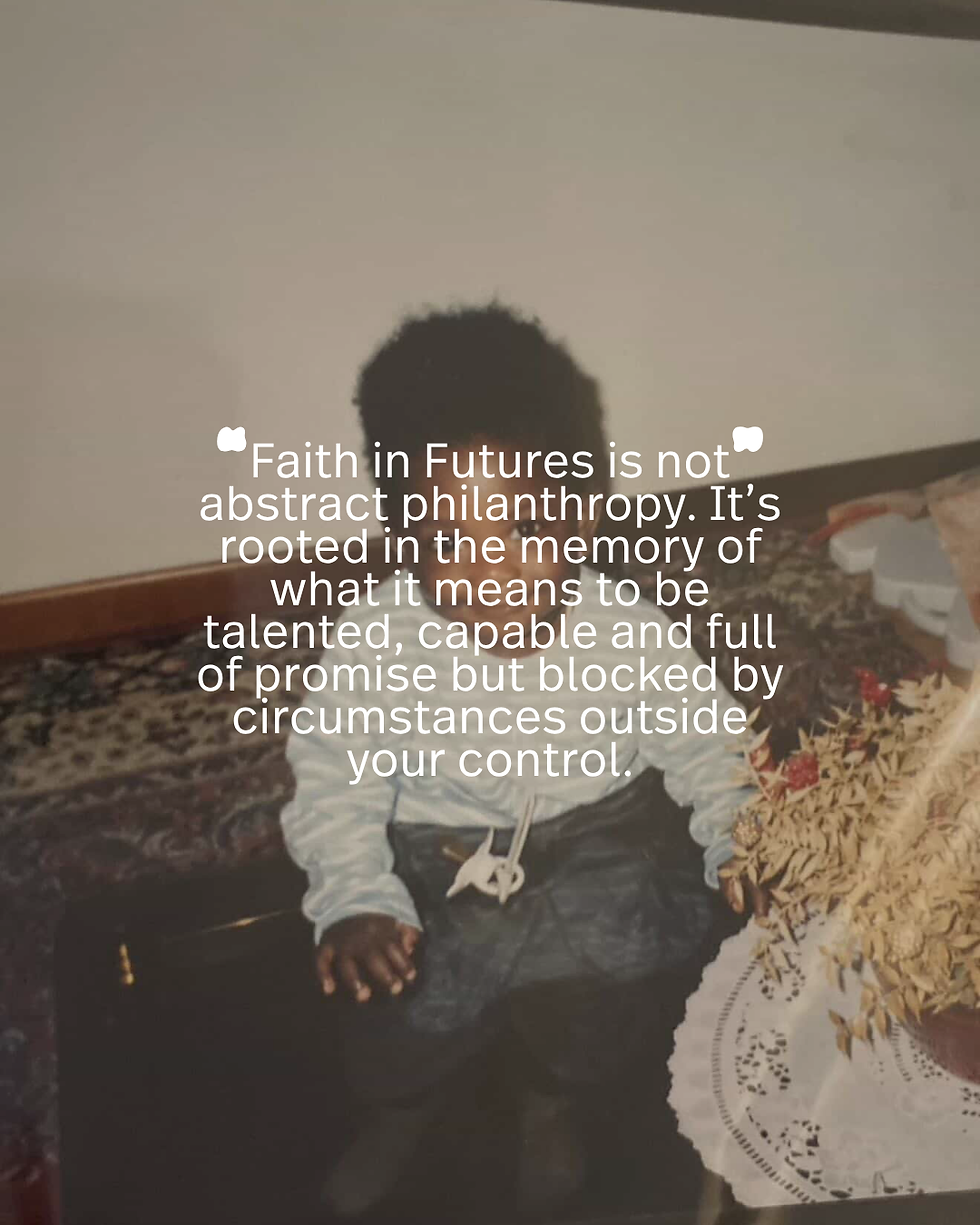
Faith in Futures may be focused on Gabriella right now, but the bigger vision stretches far beyond a single campaign.
Looking ahead, what would long-term impact look like for Faith in Futures - beyond this current campaign?
Faith in Futures was never meant to be a one-off fundraiser. The long-term vision is to build a community of people investing something as simple as £10 a month - creating a standing pot of support for future students who need it. I was actually in the middle of designing the branding and shaping the concept when I came across Gabriella’s story. And I thought: why not start here?
For those reading this, what is one way they can meaningfully support Gabriella’s journey right now?
Invest, invest, invest. Do your part by giving whatever you can. Faith in Futures will follow Gabriella’s journey and document it so that you will be able to see what your contribution has achieved regardless of how much you give whether big or small, it has great impact.
At ourppls, we often talk about the ecosystems needed for people to thrive, not just creatively, but personally, professionally and collectively.
Faith in Futures reminds us that potential does not exist in isolation. It needs infrastructure, community, belief and resources.
Gabriella has done the hard part of getting here. Now the question becomes whether the rest of us are willing to help carry her forward.
Support Gabriella’s fundraising campaign and stay connected with Faith in Futures using the links below:


Comments