The Artists Way Programme Reflection - Week 7

There’s something subtle but powerful about the idea of connection. It’s not always loud or visible, but it shapes how we move, create and respond to the world around us. Week 7 of The Artist’s Way invites us to return to this idea, not as something external, but as something we can actively recover. A connection to self, to intuition, to others and to the creative force that is God, that moves through us.
At the centre of this week was a simple but challenging practice: listening.

Not listening in the passive sense, but a deeper kind of attention. The kind that asks us to quiet the noise, soften the need to control, and trust what is already trying to emerge. In many ways, this reframes the role of the artist. Not as someone who must always produce, but as someone who is willing to receive.
This idea resonated across the group. There was a shared recognition that creativity often flows most freely when we stop trying to force it into perfection. When we release the need for everything to make sense immediately, and instead allow ideas to arrive as they are. But this is easier said than done.
Perfectionism surfaced again, this time not just as a habit, but as a form of disconnection. A quiet refusal to move forward unless the outcome feels guaranteed. For many, this was deeply ingrained, shaped by environments where excellence meant flawlessness, where mistakes carried weight, and where “good enough” was never quite enough.

And yet, in a creative context, that same mindset becomes restrictive. It delays, edits too early, and often stops things from ever being shared at all.
There was a powerful shift in how this was reframed. Rather than trying to eliminate perfectionism entirely, the group explored where it might belong. Perhaps it has a place in refining, in editing, in final touches. But in the early stages of creation, it often does more harm than good. To create freely, we have to allow ourselves to do things badly. To experiment, to try, to fail, to begin without certainty.
When asked what we would attempt if perfection wasn’t a requirement, the answers felt expansive: making music, creating films, exploring new art forms. It became clear that the fear of imperfection often limits us far more than lack of skill or opportunity ever could.

Alongside this, another emotion quietly made its way into the conversation: jealousy.
Not as something to be ashamed of, but as something to examine. The book invites us to see jealousy as a kind of map. A signal pointing toward something we desire but may not yet have allowed ourselves to pursue. This reframing shifted the energy in the room. Instead of suppressing or judging the feeling, we began to ask: what is this showing me?
Often, the answer wasn’t about other people at all. It was about missed chances, delayed action, or the desire to be more consistent, more visible, more bold. The work then becomes not comparison, but response. Turning that feeling into movement. Taking one step toward the thing we claim we want.

The “Archaeology Exercise” asked us to look back at our younger selves and consider what we needed more of. In many ways, this week felt like an invitation to offer those things to ourselves now.
To create the conditions we may not have had before. To become a safer place for our own creativity to exist.
Outside of the exercises, something else was becoming visible: the impact of the process itself.
There were moments of growth and expansion emerging in real time. One participant shared that they had launched their solo music platform and secured their first live performance. Another spoke about creating new community spaces centred around belonging and creative expression. These weren’t framed as final outcomes, but as natural extensions of the work they’ve been doing internally.
It felt like a reminder that creative recovery is not just reflective, it is active. It shifts how we show up, what we allow ourselves to pursue, and how we connect with others along the way.
At the same time, there was honesty about the challenges. Keeping up with tasks, balancing new routines, navigating energy levels. Not everything feels aligned all the time, and not every week looks the same. But even in that, there was a shared understanding: the process can be adapted.
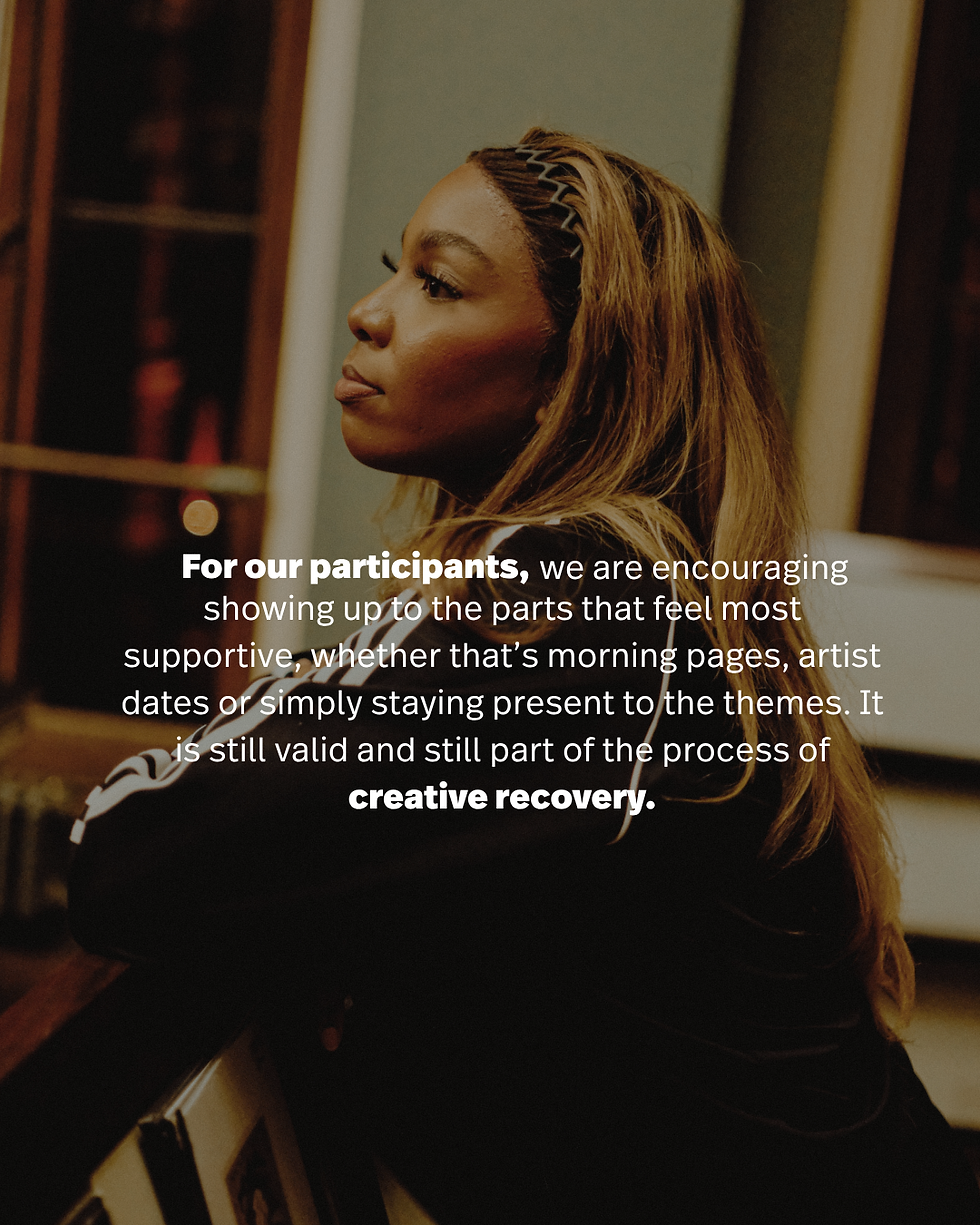
Showing up to the parts that feel most supportive, whether that’s morning pages, artist dates or simply staying present to the themes, is still valid. As we move further into the programme, connection begins to take on a wider meaning. It’s not just about creativity, but about how we relate to ourselves and the world.
If you doing the book in community is something that you are interested in, you don't have to be part of our programme to benefit from the experience of bearing witness to the transformation of life through acts of creativity in community. Julia Cameron offers a 'Creative Clusters Guide' in the book with how you can gather with friends, family or colleagues to journey the book together.


Comments