8 Key Takeaways from the Kerry James Marshall Exhibition

This past Saturday, we attended a private, curator-led tour of the Kerry James Marshall exhibition. More than simply a walkthrough of the artworks, we experienced the work through a curatorial lens. His work insists upon the expanse of Black life within the canon of art history, particularly in spaces that have historically excluded them. Moving through the exhibition collectively, we were able to slow down and ask questions. This allowed for contextual grounding. As a result we gained a deeper understanding of Marshall’s work and the following set of takeaways.
Kerry James Marshall: The Histories is the Royal Academy’s first solo exhibition of a Black artist
Kerry James Marshall's large-scale solo exhibition, The Histories, ran from September 2025 to January 2026 at the Royal Academy, London. As we near the tail-end of this landmark event, its significance lies in the fact it is premier at the esteemed institution. We see a deliberate revision of the Western canon to centre Black life and history.
"I’ve always wanted to be a history painter on a grand scale like Giotto and Géricault."
His ambition had always seemed to be amongst the greats. The first time Marshall ever boarded a plane was to see Picasso’s Guernica (1937) at the MoMA in New York. We see many a historic painter transform scenes of everyday life on a colossal scale. Marshall elevates contemporary Black life in a similar style. Depicting significant movements in Black history such as the Black Power and Civil Rights movements. We see the Middle Passage rendered in powerful paintings. These are stories we often see under-represented in art. In placing Black figures and narratives at the forefront, centuries of exclusion from art history are therefore challenged.

Marshall goes against academic rules while his work is used as teaching tools.
When we look at the works of Kerry James Marshall, he is renowned for his use of black pigments to render skin. His figures challenge the traditional academic rule that artists should “never use black”. Defying this painterly “taboo”, Marshall uses three shades of black: carbon black, iron oxide black and ivory black to make the shade chromatic. He pulls out the warm and cool tones, as any artist would with any other colour, and makes bold and powerful statements about Blackness within Western art history.

The above piece of work is part of Yale University's Art Gallery collection. Pictured, we see the subject, a painter, turn to face the viewer. Her sustained gaze demands audience engagement and one tiny detail that would otherwise go amiss: her thumbnail painted in the colours of the Pan-African flag.
Njideka Akunyili Crosby, a Nigerian visual artist who saw the work at Yale, noted Marshall's influence on her own work. Both coming from rigorous academic painting backgrounds, Crosby remarks on her aspiration “to bend conventions to serve [her] works the way that he does.” We found it so interesting how both artists respect the traditions and rules they have been taught, yet also how deftly they can subvert these same rules to make deeply affecting work. Crosby, in a Royal Academy symposium, has stated she now also uses black in her work.
The curator mentioned Kwesi Botchway and Amy Sherald, citing Kerry James Marshall as a peer and an influence, specifically with regard to the representation of the Black experience in paint. Their works, though distinct in technique, engage in a vital conversation about representation and making Black experiences visible and central.
Marshall's is not interested in depicting Black suffering and violence.
Raised in Birmingham, Alabama, during the time of civil rights unrest, Marshalls also experienced living through riots in Los Angeles and South Central whilst it was still home to the Black Panther Party. Violence and police brutality would often be the backdrop to everyday life, but these are not themes we see explicitly in any of his paintings. This choice is clearly an active one. From our tour, it was highlighted to us that there are rooms and individual paintings that hold tension, but the clear intention is that Marshall does not want to reduce Black life to oppression.
"You don’t see images of black people in trauma in my work; you don’t see images of black people who are abject in my work."
Marshall loves to feature forgotten figures in his work.
Where portraiture would have been reserved for the rich and wealthy, we see Marshall bring forgotten historical Black figures to the foreground. Figures that were not fortunately painted in their lifetimes. In playing tribute to the enslaved, past artists and activists, it poses questions: “Which bodies have been previously invisible? Which figures have been excluded from painting’s history?” (Tate, 2018)

Due to the large-scale nature of his works, we have always drawn parallels between Kerry James Marshall and Georges Seurat. The formal organisation of Untitled (London Bridge) reworks the composition of Seurat’s A Sunday Afternoon on the Island of La Grande Jatte, 1884–6. The use of double displacement, as highlighted by the exhibition’s curator, here reclaims power. The inclusion of non-Black figures in the piece is a deliberate choice to challenge racial hierarchies. One thing we found interesting in this rare instance was the range in tones of the white-painted figures.
In the painting’s centre the main subject, a Black man, carries a sandwich board advertising “Olaudah’s Fish & Chips”, a reference to the former slave turned writer, Olaudah Equiano, who would go on to play a major role in the abolition movement.
The same figure also appears in The Abduction of Olaudah and his sister, depicting Marshall's imagination of the real-life event which took place in present-day Nigeria, when Equiano was around the age of eleven. He was then sold into slavery in the Americas and eventually gained his freedom in 1766. He became a well-known writer and abolitionist in London, where he settled as a freedman. Equiano went on to detail his abduction in his 1789 autobiography, The Interesting Narrative of the Life of Olaudah Equiano, which became a key text in England’s abolitionist movement.
De Style (1993) and School of Beauty, School of Culture (2012) are sister works.
De Style (1993) was the first of Marshall’s works to be acquired by a major museum; it was his largest work to date and set a precedent for many of the works he would later become known for. The paintings depict Black barbershops and salons as vital cultural hubs; such beautiful portrayals of contemporary Black life each have subtle nods to art history.
De Style depicts five Black men, four of them facing the viewer. Three wait, and one sits in a chair as the barber cuts his hair. In School of Beauty, School of Culture, we have a vibrant hair salon with women interacting and getting their hair done. For many Black communities across the globe, both the barbershop and salons are safe spaces.

Marshall brings the piece on the left into contemporary events by depicting a calendar marking April 1991 – the month after Rodney King, a Black man, was brutally beaten by the Los Angeles police. Then looking at a close-up of the salon on the right, we noticed an anamorphic image of Sleeping Beauty, the distorted jarring version of the fairytale, standing to represent beauty standards from an alternate reality.
In both paintings, Black everyday life is projected to the scale and significance of traditional history painting, with Black men and women rendered with reverence. For Kerry James Marshall, it is imperative to see the Black community in this genre of just existing. So beauty and pleasure come to be seen as an exclusively white entitlement. David Zwiner (2018)
“We don’t think of Black people and joy.”
Marshall often bends time in his work
Marshall bridged past and present in his works. In A Portrait of the Artist as a Shadow of His Former Self, Marshall’s medium of egg tempera evokes the Renaissance period due to being an ancient, precise technique associated with early Italian painters such as Giotto. By working through modern abstraction, Kerry James Marshall reclaims historical narratives, asserting Black agency within it.
Marshall’s work is always profoundly layered in its references to history, politics and religion. In his art, the past is never truly past: history exerts a constant, often unconscious pressure on the living. (NGA, 2014) Merging Black history with traditional art history, we see scenes from the Middle Passage, the Civil Rights movement, and daily Black life. The phrase "pastoral collage" from David Zwiner (2018) perfectly describes these time-bending canvases. The "Souvenir" Series (1997–98) acts as memorials, featuring images of civil rights leaders like Martin Luther King Jr alongside scenes of contemporary domestic life. On the tour, the curator mentioned middle-class African American visitors to the gallery being moved by the nostalgic references pictured.

The number ‘7’ is often seen as a motif in Marshall’s work
The “Seven African Powers” in Marshall’s work refers to a pantheon of gods from Yoruba tradition. Each is a different deity (Orisha) that he incorporates into his work to reanimate them as Black superheroes. Knowledge of African spirituality and history is brought to the forefront, elevating it to the same status as Western mythology.


In the above images the dominant theme is the transport of African slaves to America in the Middle Passage. Marshall’s inclusion of the Red Cross in these paintings is not to be confused with the non-profit charity. Here the use is syncretic: referring to Eshu, the god of crossroads and transitions, as well as the red being associated with rescue and distress.
Eshu is known in Yoruba spirituality as also being the trickster. His presence, therefore, on slave ships as they travelled may aid Marshall in his navigation of the complex legacy of slavery, especially with regard to his own African American identity.
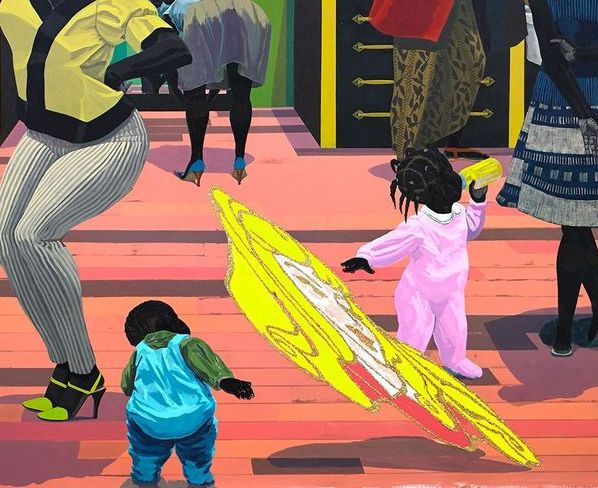
Use of glitter was never an afterthought
Kerry James mentioned in an interview with the Royal Academy that one of his main motivations for wanting to become an artist was a scrapbook that one of his schoolteachers had. In kindergarten, the Christmas cards scrapbooked, in particular, stood out. Those with glitter are always having the greatest impact. Marshall appreciated the enhancement by adding an extra dimension to a piece.
“The glitter in my paintings is the magic.”
In our favourite paintings across the entire exhibition, the curator revealed a profound detail. We see on the right-hand side of Untitled (Club Scene) two figures have been painted as though the light from the red glitter is reflecting off their backs. We were struck by the meticulous level of detail and intentionality that characterises Marshall’s work. Each glitter element appears carefully premeditated rather than incidental.

Written by: Bridget Eke


Comments