Fashion Is Art — Or Was It? The Controversy of the 2026 Met Gala
The Met Gala gave the fashion world an easy one this year. The dress code for the Costume Institute's Costume Art exhibition was a thesis statement, not a prompt: Fashion Is Art. Not fashion inspired by art. Not fashion referencing art. Fashion — the designed, constructed, worn object — declared as art in its own right. All guests had to do was prove it.
What the carpet revealed instead was a gap between what the museum was arguing inside and what most guests were willing to commit to outside. This wasn't a creativity problem. It was an effort problem. The theme was open, generous, and almost impossible to get wrong, and yet the overall effect was a night that felt smaller than its brief.
There are years when the Met Gala feels like a genuine cultural event, a night when fashion does what it can uniquely do: collapse history, provoke feeling, assert beauty as a form of argument. The looks that worked did so because they took the theme seriously as an intellectual proposition, not just a dress code. They showed what happens when fashion is treated as the art form it is: the result is something no other medium can produce. The rest of the carpet was a reminder of the risk the Met runs when it opens its doors too wide to celebrity and closes them to actual creative rigour.
The Met Gala has always been a disproportionate display of wealth. This night, the tension ran deeper than the carpet. The Costume Institute's work matters. It argues that fashion deserves to be preserved, studied, and taken seriously as cultural expression. You cannot talk about the purpose of art, its role in building community and connecting people across history, while that community waits outside in this current economic and social climate.
Backlash began weeks before the red carpet was rolled out. Covert boycott advertisements appeared across New York City subway platforms in April. Workers at the Metropolitan Museum itself — who earlier this year voted to unionise — disclosed publicly that 91% of hourly Met staff in their bargaining unit earn below a living wage.
The catalyst was the sponsor. Jeff Bezos reportedly contributed $10 million to underwrite the evening, and it is worth saying plainly that Lauren Sánchez, his wife, would not have been at that table on her own terms. What money cannot buy directly, it buys through proximity. A $10 million cheque to the Met is, among other things, a cultural access pass. Typically, the gala is backed by luxury fashion brands; in recent years, tech companies, including TikTok, Instagram, and Apple, have also taken that seat. But Bezos is not a tech company. He is the wealthiest individual in the United States, operating in a moment where Amazon's displacement of its own workforce has made the mechanics of that wealth impossible to ignore. This is not a new kind of sponsor. It is the same move, made visible, culture as something you buy your way into when the door wasn't opened for you.

Outside, activists staged the ‘Ball Without Billionaires’, an outdoor runway show in the Meatpacking District featuring emerging designers and the very Amazon workers fighting the company from the inside. There is also the question of protest and attendance. If you attend, you are there. Your presence is not a footnote; it is the statement. The red carpet does not care about your politics; it only records your choices. And the choice to walk it, in this particular year, with this particular sponsor, in this particular political and economic landscape, says something that no post, no caption, and no carefully worded interview can unsay. Performative protest has a tell: it costs nothing. You cannot preach from the street and dine with the reason the street is full. If you are in the room, be in the room. But do not ask us to believe you are also outside it.
For a theme this generous, this year's carpet was a disappointment. There was a pervasive lack of ambition, a sense that many attendees had dressed for a gala, not the Met Gala. Fashion Is Art is one of the most accessible themes the Met has ever offered, and the overall execution left people hungry.
That said, where it shone, it shone.
Beyoncé, returning to the Met steps for the first time in a decade as co-chair, wore a custom Olivier Rousteing gown, sheer, with a diamond-traced skeleton, beneath a feathered coat fading from beige to deep grey. The concept is legible. The execution wasn't. The dress needed a sharper, more fitted silhouette; ending at the ankles would have cleaned it up considerably. Too many diamonds pushed it toward overwhelming rather than striking; the crown felt unnecessary, and the coat, rather than elevating the look, just added noise. Whilst Rousteing is undeniably talented, this was not his finest hour.
Her second look is a different conversation. Robert Wun's reference, a city at night from above, Earth as a constellation, is strong and beautifully executed. The concept is imaginative, the craftsmanship is evident. That should have been the look on the steps.

Naomi Osaka delivered what may have been the single most theatrical moment on the carpet. She arrived in a dramatic white sculptural Robert Wun gown, exaggerated shoulders, cascading red feathers, a matching headpiece, two-toned gloves, and then, mid-carpet, opened the dress and removed the headpiece entirely to reveal a completely different look beneath: a sleek red beaded gown with the form of a body embossed into it. A reveal within a reveal. The outer look was already in dialogue with a similar Wun piece hanging inside the Costume Art exhibition itself, making this one of the few looks of the night genuinely in conversation with the institution hosting it. That is what the Met Gala is supposed to feel like.

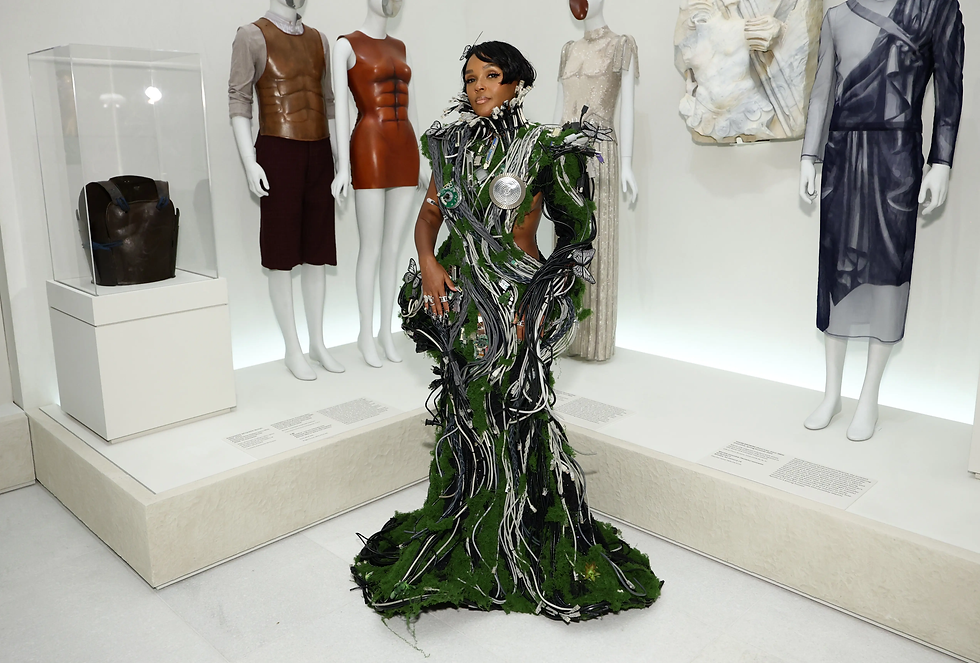
Janelle Monáe came in a Christian Siriano gown constructed with electrical wires, cables, live moss, succulents, and animatronic butterflies. The living, breathing garment was a literal argument that fashion and nature are inseparable art forms, and Monáe said as much on the carpet: "Remember what made you human. Nature is talking to us." For a theme about fashion as art, this was not interpretation. This was a manifesto.
Sabrina Carpenter, a member of this year's host committee, arrived in a Dior dress designed with film strips from the 1954 film Sabrina — her own name, her own cinematic history, worn on her body. The concept was personal and precise: fashion as autobiography, as self-portraiture. She blended two art forms — cinema and couture — in a way that felt considered rather than costumed.

Emma Chamberlain, serving as one of Vogue's red carpet hosts for the evening, arrived in a custom hand-painted Mugler gown by Miguel Castro Freitas, a body-hugging, long-sleeved dress dipped in a full spectrum of colour from décolletage to spiral train, with fringe falling from the cuffs. As the person conducting interviews on the steps, she was wearing the thesis of the night before anyone else had even arrived. That is not a small thing. Chamberlain has quietly become one of the most reliably interesting dressers in this space, the look of someone who takes fashion seriously without taking themselves too seriously. Arguably one of the best dressed of the night.

Paloma Elsesser was, without question, one of the best-dressed. She arrived in a painterly Francesco Risso creation, her glam team described it as "subversive, sexy, skin”, reportedly constructed from deconstructed vintage dresses sourced on eBay and reworked into a single sculptural piece. With its metallic, brushstroke-like surface and almost hand-rendered quality, the dress treated the body less as something to be styled and more as something to be composed upon. In a night of varying levels of interpretation, Elsesser's look was among the most fully resolved: editorial, sculptural, and uncompromising. The kind of Met Gala moment that feels inevitable in hindsight.

Yseult, the French singer and fellow committee member, wore a Harris Reed creation — a sculptural black dress framing a dramatic corset. Harris Reed has built a body of work that interrogates gender, the body, and power, and this was no exception. Yseult wore it with exactly the right energy: unapologetic, confrontational, complete.

Heidi Klum, who has made transformation her brand long before the Met Gala cared about it, arrived draped as a living statue, a callback to classical sculpture, executed with the same commitment she brings to her legendary Halloween appearances. Theatrical, yes. But earned theatricality.
Kylie Jenner wore Schiaparelli, an illusion dress featuring 10,000 pearls and reportedly 11,000 hours of embroidery work, with lightened brows to match. The craftsmanship is beyond question. The look played with the naked dress concept in the house's signature surrealist register. Whether it rises to the level of art or remains exquisitely expensive fashion is precisely the kind of question this theme should have been provoking all evening.

And then, as always, nine minutes after the red carpet officially closed, the dubbed queen of the Met, Rihanna, arrived draped in a metallic look from Maison Margiela FW25 Couture by Glenn Martens, constructed from silk and metal wiring, reportedly drawing on medieval Belgian architecture. In describing the look with Essense, Rihanna leaned into a metaphor, “it’s giving oyster”, something like emerging from a shell, protection giving way to exposure. Whether read literally or symbolically, it aligned with her long-standing approach to fashion as narrative rather than decoration. Was it her most daring? No. But "not Rihanna's most daring" still clears about ninety per cent of the carpet. And her timing, as always, remains its own art form.

The rest? Black gowns. Safe silhouettes. Red carpet formulas. Looks that were perfectly lovely and utterly disconnected from the theme they were supposedly dressing for. The tragedy of the 2026 Met Gala is not that bad looks existed; it is that so many people with extraordinary resources, extraordinary access to designers, and an extraordinarily clear brief simply chose not to try. If your look can be worn to any other red carpet, is it Met Gala worthy?
The 2026 Met Gala will not be remembered for what happened on the steps. It will be remembered for what happened outside them. The controversy was the show. When the event surrounding the fashion is more compelling than the fashion itself, the industry has a question to answer. This year, the world found something far more interesting to look at than the carpet, and the carpet gave them very little reason not to.
All looks and context drawn from coverage of the 2026 Met Gala, held May 4, 2026, at the Metropolitan Museum of Art, New York.


Comments